

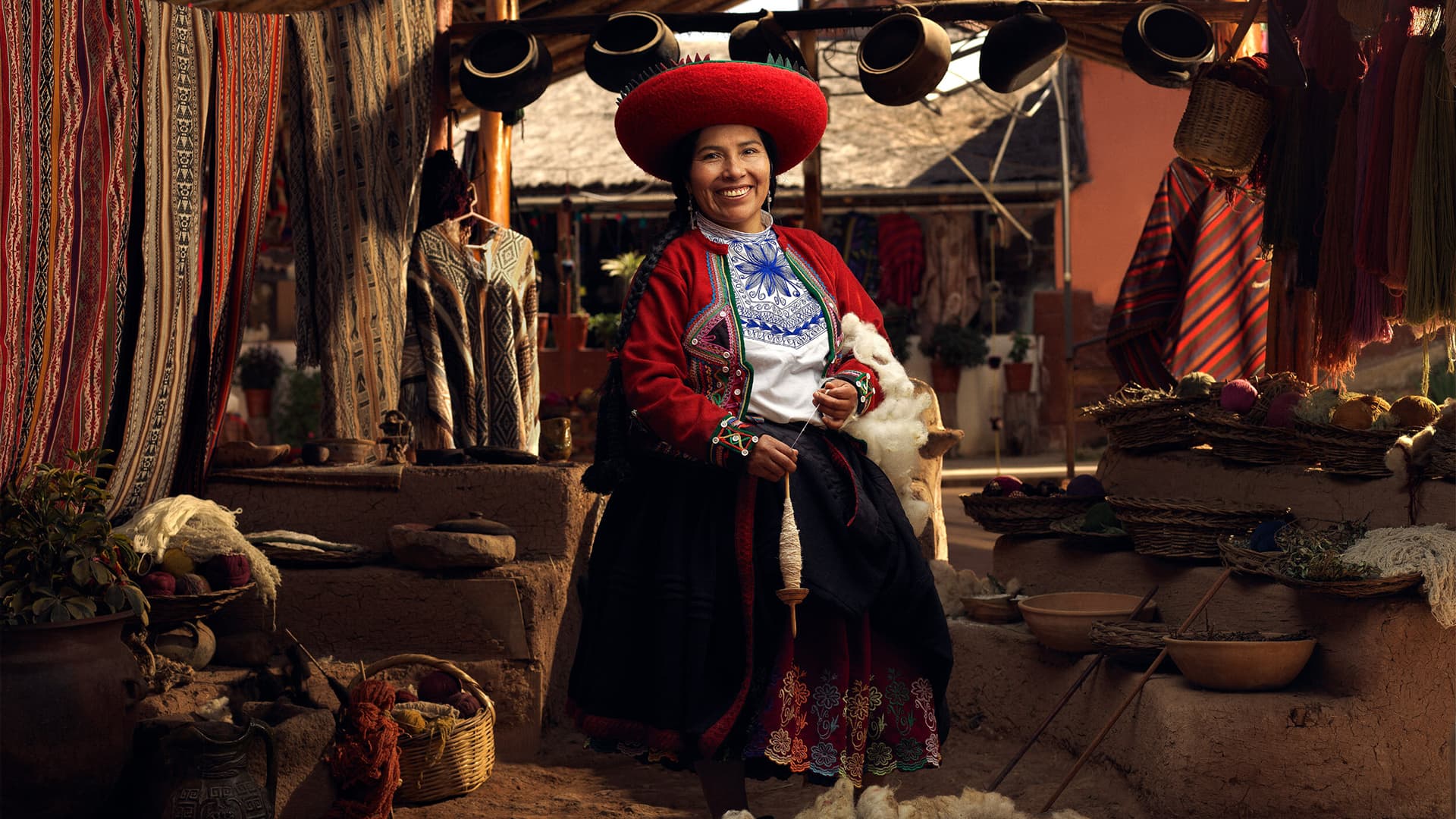






Discover one of the most fertile valleys in southern Peru, the Sacred Valley of the Incas, which has been an important region since ancient times due to the richness of its lands nourished by the waters of the Willkamayu River (Vilcanota River). Within this valley, you will appreciate beautiful towns that still cultivate products such as corn and potatoes, along with three important archaeological centers that had great significance during the Inca era.
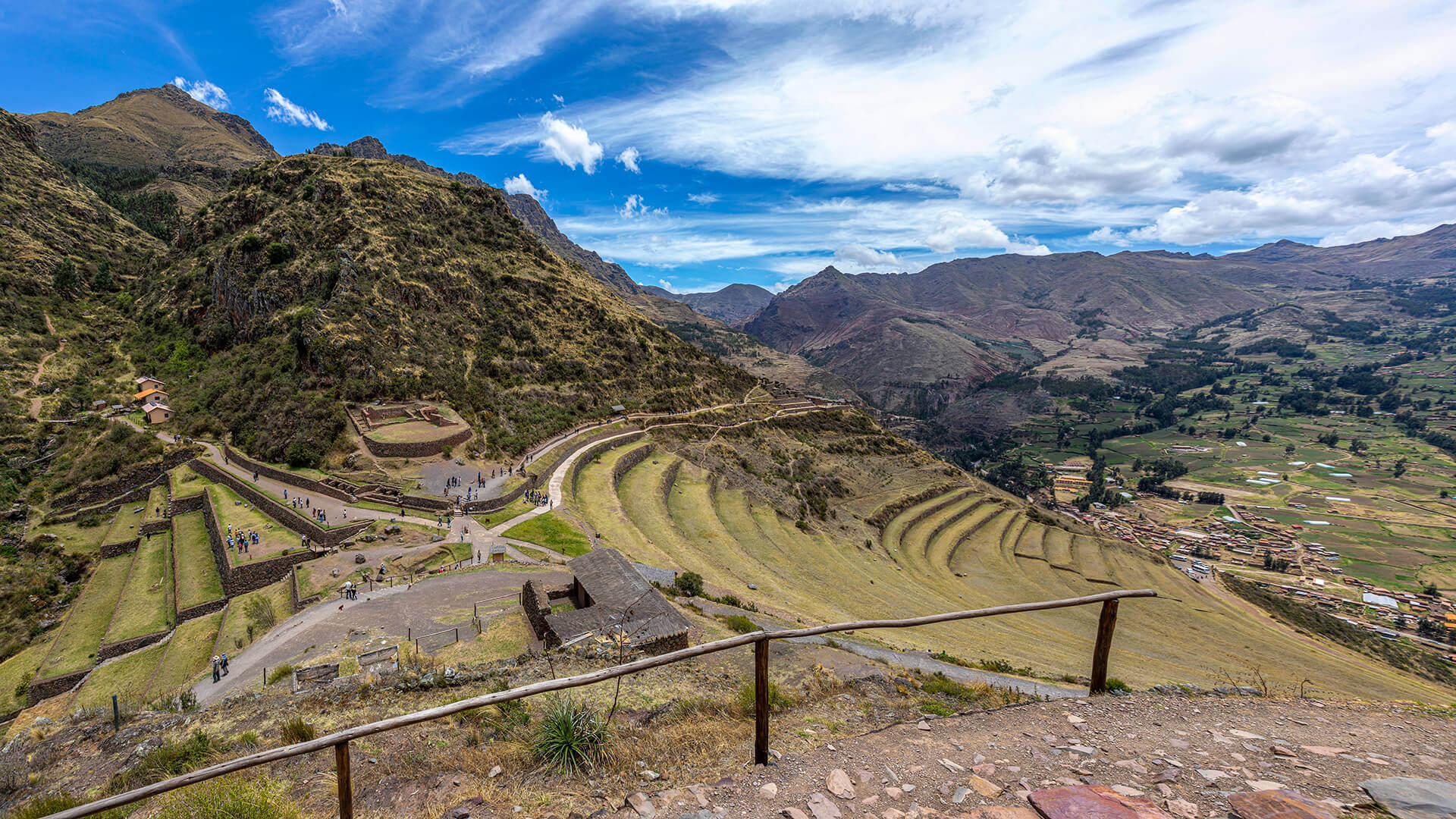
Our first stop will be in Pisac, where we will explore both its artisan market and its impressive archaeological zone. Here you can appreciate and purchase unique crafts, such as textiles, ceramics, and jewelry, handmade by talented local artisans.
Next, we will enjoy a delicious buffet lunch in the heart of the Sacred Valley. This lunch is offered in a three-star restaurant and features a wide variety of appetizers, main dishes, and desserts made with fresh regional products, allowing you to savor the best of local cuisine.
We will continue to Ollantaytambo, an Inca archaeological complex characterized by its imposing agricultural terraces and fascinating history. For those wishing to continue to Machu Picchu, Ollantaytambo is the ideal connection point to take the train to Aguas Calientes. For the others, the tour proceeds to Chinchero, where we will learn about the rich Andean textile tradition and enjoy the charm of this town, surrounded by spectacular Andean landscapes.
In comparison to the VIP Sacred Valley Tour, which includes five stops (Chinchero, Moray, Salineras de Maras, Ollantaytambo, and Pisac) and offers shorter stays at each site (30 to 40 minutes), the classic tour focuses on three main destinations and provides more time to explore each place, ensuring a more relaxed and enriching experience.
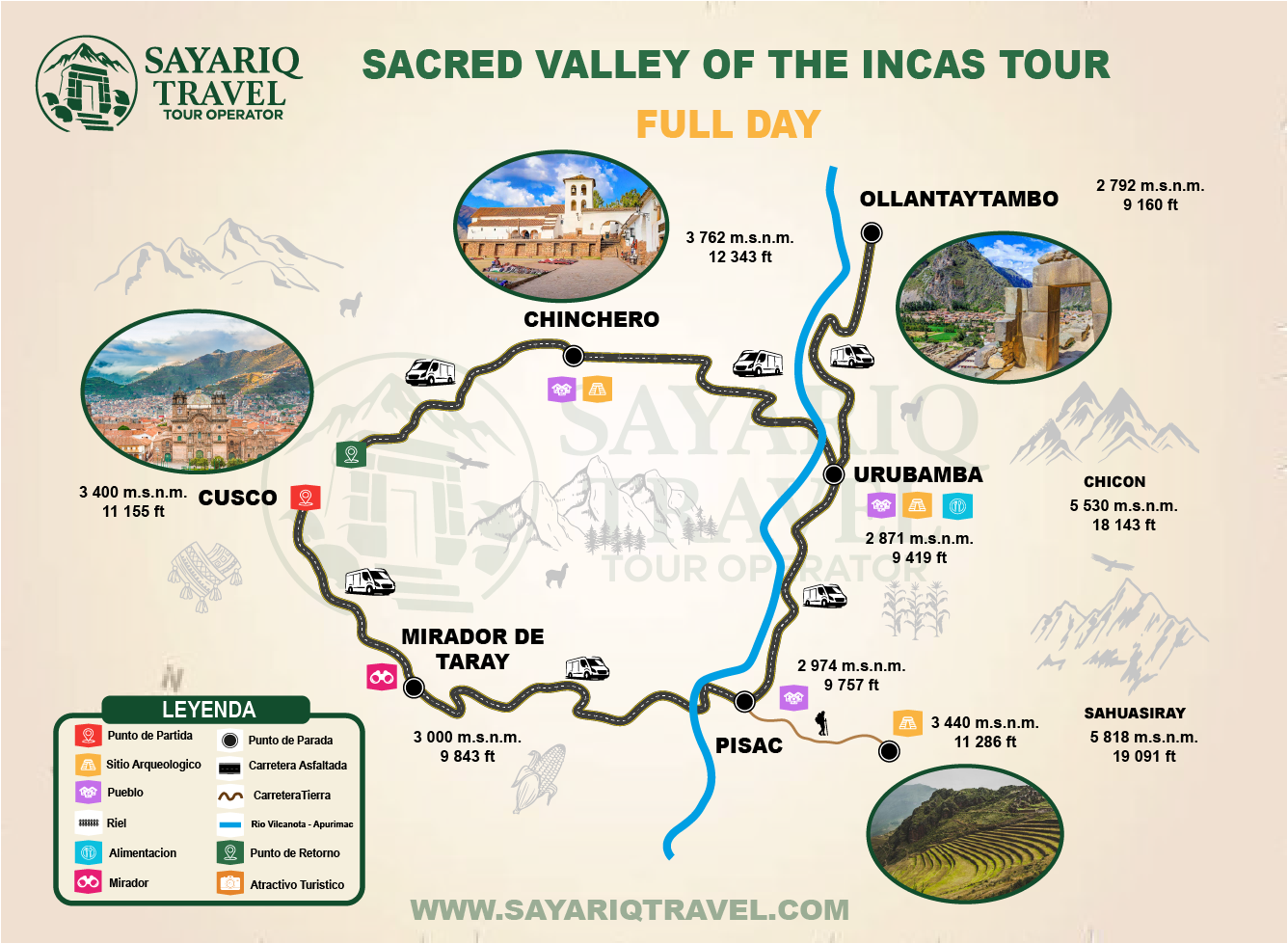
On this day, we will pick you up from your hotel between 7:30 and 8:00 a.m. to begin our tour at 8:00 a.m. In Inca times, the Sacred Valley held immense importance in agricultural production, especially in the cultivation of large-grain corn, a tradition that endures to this day. During the tour, you will visit the picturesque towns of the valley that showcase a unique blend of cultures, arts, and architecture.
First, we will explore THE TOWN OF PISAC AND ITS ARTISAN MARKET, along with the adjacent ARCHAEOLOGICAL SITE, where you will spend approximately 40 minutes enjoying the history and scenery. Next, we will head to Urubamba, where you will enjoy a delicious buffet lunch featuring typical regional dishes, scheduled for 2 p.m. The duration of lunch will be approximately 1 hour.
The journey will continue to the ARCHAEOLOGICAL PARK OF OLLANTAYTAMBO, a site with origins dating back to the 15th century, where you will spend approximately 1 hour. Finally, we will visit CHINCHERO, a place that has preserved its textile and ceramic traditions. Here, you will explore its colonial church, which houses notable paintings from the 15th and 17th centuries.
We will return to Cusco, where the transportation will drop you off just 2 or 3 blocks from the main square. This concludes our tour, which ends around 7 p.m.
In private tours, breakfast and lunch are provided at higher-category restaurants that offer greater culinary variety.
This tour requires a General Tourist Ticket or a Partial Tourist Ticket to visit Pisac, Ollantaytambo, and Chinchero. For more information about Tourist Tickets, see the ‘Recommended to Bring’ tab.
If you plan to visit most of the important tourist sites in Cusco during your stay, we recommend purchasing the General Tourist Ticket to save costs on entries and simplify your trip.
To purchase your Tourist Ticket, you must bring Peruvian soles.
It is not necessary to carry a passport.
THE SACRED VALLEY OF THE INCAS is located at an altitude of 2790 meters above sea level.
Pisac is divided into two zones: the old one, located in the upper part, is an Inca archaeological site, and the current one, situated in the valley, dates back to colonial times. The main square is a lively place filled with colorful handicrafts for sale. This town is renowned for its astronomical observatory.
Pisac’s architecture reflects a mix of indigenous and mestizo influences, with Viceroy Toledo’s constructions built upon Inca remains. Here, you can attend a mass in Quechua, amidst indigenous people and regional mayors. Moreover, you can witness how the Inca agronomists ingeniously solved the problem of planting crops on the slopes of the hills.
Pisac is a prominent tourist attraction due to its Inca archaeological site, forming part of the archaeological circuit of Cusco, along with Ollantaytambo and Machu Picchu, making it a significant source of income for the town, aside from subsistence agriculture.
Pisac is also home to famous Inca legends. Notably, a statue represents the story of Chief Huayllapuma’s daughter, Inquill. According to the legend, she was to marry the man who could build a bridge over the Willcamayu River (now “Vilcanota” or “Urubamba”) in just one night, as it was essential for the place’s defense. Despite the challenging task, Asto Rímac, a handsome prince, accepted the challenge and asked for the princess’s hand. The local authorities arranged everything for Asto Rímac to begin the work, while the princess had to climb a hill without looking back; otherwise, she and her fiancé would turn to stone. Almost at dawn, the prince finished the work, but Inquill, unable to bear the wait, turned around and has remained turned to stone ever since.
Pisac is a Peruvian town located in the Cusco region, in the province of Calca, and is the capital of the Pisac district. Situated at an altitude of 2,966 meters above sea level, the town is well-known for its craft fair.
At the mountain’s peak lies the archaeological park of Pisac, constructed between the 10th and 11th centuries.
Ollantaytambo (in Quechua: Ullantaytampu, “warehouse or inn of Ollanta”) is a Peruvian town and Inca archaeological site, serving as the capital of the homonymous district located in the province of Urubamba, in the department of Cuzco. It is situated approximately 90 km northwest of the city of Cuzco.
During the Inca period, Pachacutec conquered the region and built the town along with a ceremonial center. At the time of the conquest, it served as a fort for Manco Inca Yupanqui, leader of the Inca resistance. Unlike other archaeological sites in Cusco, Ollantaytambo features resistance platforms (to prevent landslides) rather than agricultural ones. Today, it is an important tourist attraction due to its Inca constructions and is a common starting point for the Inca Trail to Machu Picchu.
Chinchero is a Peruvian town and the capital of the homonymous district located in the province of Urubamba, in the department of Cuzco. It is the birthplace of the hero of Peruvian independence, Mateo Pumacahua, who participated alongside the Angulo brothers in the Cuzco Rebellion of 1814.
The town had a population of 3,765 inhabitants according to the 2017 census. It is situated approximately 30 km from the city of Cuzco, at an elevation of 3,754 meters above sea level.
The monumental zone of Chinchero was declared a historical heritage of Peru on December 28, 1972, through the R.S.N° 2900-72-ED Archaeological Park with the National Directorial Resolution No. 515 of the year 2005.
The Chinchero Archaeological Park covers an area of 34,800 hectares. Chinchero was inhabited before the Inca Empire. During the Tahuantinsuyo, the Inca Tupac Yupanqui planned the construction of palaces for the elite. Currently, you can see the remains of the palace upon which the colonial church stands.
Accepted Payment Methods





 Cusco Tours
 Adventure Tours
 Adventure Tours
 Adventure Tours